
Aaron Charlton · November 1, 2024
What I learned from Analyzing 35,000 1-Star Reviews of Doctors’ Offices
An exploratory analysis of 35,148 one-star reviews reveals recurring problems with communication, scheduling, billing, and wait times.

Summary: Analysis of 35k patient complaints reveals key areas affecting patient satisfaction, from poor communication and scheduling issues to billing frustrations and long wait times.
One of the best ways to make a medical practice more sustainable is by improving the patient experience. When your patients are happy, you can expect to see higher patient retention, fewer cancellations, more referrals, and lower employee turnover. But how can you know where to start? One key to figuring it out is found in the 1-star patient reviews. Yeah, many of them are unfair or false, but there’s also a goldmine of information in there if you dig. That’s why I decided to analyze a large chunk of 1-star patient reviews to see what the general patterns and issues are. I hope you get a lot out of it and please follow us for more content like this.
Watch the video overview on YouTube.
Analysis of negative feedback aimed at doctors’ offices
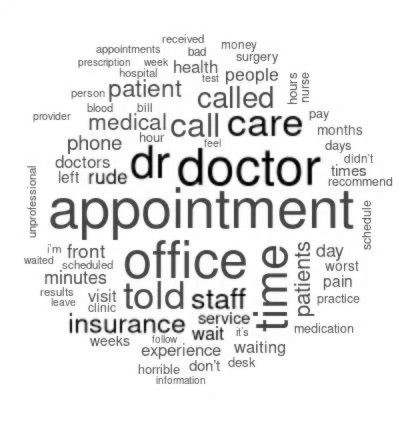
For this project I’ve analyzed 35,148 1-star reviews of doctors’ offices in Phoenix, Arizona. Note that this is unstructured (non-numerical) data so it’s difficult to aggregate the data and hard to know the most transparent, accurate way to analyze it in many cases. It should be considered exploratory/preliminary. For the analysis, I used a combination of R statistical programming tools (word cloud, percentages, sampling, etc.), ChatGPT for summarizing and categorizing data, and I manually studied a random sample of 100 reviews. I’ve also worked in and around doctors’ offices for many years, much of that time spent soliciting and reviewing patient feedback. The word cloud to the left is a visualization of all the data. My goal for this project was to identify patterns that would help the reader have an idea of where to look for problems in their own practice. Some are going to be easier to fix than others, and some say more about the patient or their insurance than they do about the doctor’s office receiving their wrath.
During my analysis, several key patterns emerged revealing systemic issues in the interface between patients and their doctors’ offices. Below I’ve outlined the primary themes:
Even dissatisfied patients tend to like their doctor

“Good doctor, but the company is extremely difficult to deal with”
Complaints about physicians and other healthcare providers are not as common as you may think. Most people seem to assume that their provider is knowledgeable and compassionate. They typically blame the company and its support staff for most of their frustrations. Many 1-star reviews actually praise the doctor they saw, though they disliked everything else about their experience. But some did complain about their providers. Here are some of the major issues patients had with the providers:
- Incorrect diagnosis. Not being able to correctly diagnose the problem is a big issue for patients. In one case, for example, a physician ordered a surgery to remove cysts. During the procedure none were found, meaning the surgery was unnecessary in the eyes of the patient.
- Unnecessary procedures. Patients often inferred that their providers are just in it for the money and are proposing diagnostics and treatments that benefit themselves more than the patient.
- Poor attitude. Many patients complained their providers were rude, condescending, and dismissive. “Then when Dr. X finally came in he looked me up and down like he was silently discriminating against me already.”
- Insufficient attention. Visits seem rushed, too much time spent doing data entry, lack of pleasantries, not listening to patient concerns, etc. “The doctor… wouldn’t ask if I got any question. She walked out of the exam room without letting me know that the visit came to an end.”
Breaking down complaints directed at clinic & staff

“This is the absolute worst office I have ever been to. I pray that no other patient gets sent to his office.”
Generally, the person at the front desk gets blamed for the wait time, not the doctor who is running behind. This is true of most issues. They also blame the company, inferring corporate motives of greed, lack of caring, etc., when they have a bad experience. Here is my attempt to put the complaints into boxes:
- Poor communication. Complaints frequently highlight poor communication from both medical staff and administrative personnel. Patients expressed frustrations over not being able to reach staff, lack of follow-up on messages, and feeling uninformed about their healthcare needs and procedures. There’s a consistent theme of patients waiting for long periods (often over an hour) without updates on their status during appointments or for test results. A lot of the communication issues relate to billing and scheduling which are covered in sections below. A few examples of communication issues:
- “The automated prompt said my wait was 6 minutes only to have my call dropped 30 minutes later without ever speaking to someone.”
- “It is absolutely impossible to speak to anyone … I get told oh don’t worry, I will make this my top priority, then hear nothing back for days or even sometimes weeks.“
- “Terrible customer service, waited on hold for 37 minutes before being sent to a voicemail and never received a call back. Good luck getting ahold of anyone they don’t answer the phone even after their voice message says, ‘phone calls will be returned same or next business day.’”
- Lack of empathy and professionalism. Countless reviews describe staff (including providers) as rude (15.5% of all 1-star reviews), unprofessional (8.1% of reviews), dismissive, or lacking compassion. Positive interactions were often contrasted sharply with negative experiences involving other staff members. Patients noted that they often felt their concerns were not taken seriously or treated with indifference, particularly when discussing sensitive issues. A few quotes from reviews:
- “The front staff is rude, incompetent and dishonest… we have tried to work with this office for 7 months, and it was a waste of time.”
- “The woman up front… was EXTREMELY RUDE, talking to me like I’m an idiot when I can guarantee I am far more educated than her.”
- “I was treated very rudely and not seen for at least an hour past my appointment time.”
- “The call center provides you with wrong information and does not communicate with the actual health care facility.”
- “The people at the front office desk have attitudes and they’re dismissive.”
- “They are very unprofessional and they seem to not care about the HUMAN PERSON as much as they care about your money.”
- Scheduling issues. Patients often encountered difficulties when trying to schedule appointments, as well as errors in appointment management (e.g., being labeled as new patients vs. established ones). Being seen in a timely manner was also an issue, with urgent problems being up off for months. Some examples:
- “The scheduling is a NIGHTMARE!!! It took three separate calls to get through and then once I did, I was placed on hold and forgotten.”
- “I scheduled a 9:20 appointment (the first one of the day)… only to find out the doctor didn’t arrive until 9:35.”
- “Scheduled an appointment but when I arrived they informed me that I was a new patient and did not have the necessary paperwork.”
- “I had an appointment at 12:30 they called me and asked if I could exchange it for a different time… then they called back saying they couldn’t do that day at all.”
- Billing and insurance verification 💵. Terms related to insurance came up in at least 19.3% of complaints. And many of the most fiery complaints are centered around billing, with people feeling like they’ve been ripped off. Most of these issues seem to stem from the pre-visit insurance verification stage as opposed to the post-visit billing stage. Generally, people complained of being blind-sided by unexpected out-of-pocket costs. A few examples:
- “I was billed almost $300 even though my insurance covers urgent care visits.”
- “After seeing the doctor, I got a bill for $700, which did not match what I was told over the phone prior to my appointment.”
- “They are trying to charge me for determining my BMI and for surveys that are required to complete before going to therapy.”
- “Incompetent and dishonest billing practices; they sent my bill to collections without notifying me, and the charges didn’t match what the insurance had covered.”
- “They tried to charge my insurance for appointments they improperly marked as attended when I actually had been a no-show due to their miscommunication.”
- Long wait times. Around 41% of complaints mentioned something about waiting and/or time being wasted. Wait times for appointments (both in the waiting room and in the exam room), often happened with no clear reason for the delays or adequate communication from staff. They also had to wait too long for lab results, provider availability, on the phone, etc. A few examples:
- DOES IT REALLY TAKE 3 WEEKS TO GET A VIAL OF ALLERGY SHOTS?
- Set up an appointment at 7am because of work at 8am, got all checked in. Was than informed their medical staff doesn’t show up until 8:30am…
- You will NEVER be seen on time when you schedule an appointment…
- With my visits, I was usually treated very rudely and not seen for at least an hour past my appointment time…
- 50 minutes on [sp] the waiting room for a simple sport physical for my kid and still waiting…. just unbelievable.
- After 2 hours of waiting, Dr. G.. never even bothered to show up for the appointment.
Start by fixing the back office

A good back office can make all the difference
I noticed that the bulk of these complaints are directed primarily at the back office staff (scheduling, verification, prior auth, billing, etc.), not as much at the medical assistants and providers seeing people on site (some exception is made for the front desk, though, who are mentioned in at least 8% of reviews–and usually not in a positive way). So, if you could be the doctor with a solid back office, you could achieve a really high level of patient satisfaction. That’s true in theory, anyway.
The overall pattern suggests that substantial systemic improvements in the areas of communication, patient support, and overall staff accountability could help restore trust and ensure a positive patient experience. It may be beneficial for medical practices to implement more robust patient feedback systems, training for staff on communication and compassion, and clearer protocols for diagnosis and treatment discussions. On the other hand, Improvements to the way the actual medical staff renders care would probably not have as large of an impact on overall patient satisfaction based on this data. This may be due to the fact that it is difficult for a patient to evaluate quality of medical diagnosis and treatment but it’s easy for them to tell when your phone tree is a disaster.
In future installments, I’ll make a deeper dive into different aspects of a healthcare practice that may be improved (verification, front desk, etc.).